
Detention Center Release Destinations
The official Granville County detention page says the facility houses people until trial and disposition. That can end in several ways. A person may post bond, leave under a court order, receive time served or probation, finish a misdemeanor sentence, or move to another custodian after a judgment or hold. The Sheriff’s release entry should distinguish those outcomes.
A community release ends the county detention episode without a receiving jail or prison. A transfer also ends that booking’s local custody, but it does not mean the person is outside confinement. NCDAC may receive someone after a felony judgment. Another county can take custody on its case, while a federal writ, detainer, or immigration process can lead elsewhere. Ask for the destination or receiving agency instead of treating “not here” as a complete answer.
Confirm Detention Center Releases
Start with the last known Granville County booking. A full name plus booking number provides the safest match. Date of birth can help distinguish names, but it should be used with care and not repeated when it adds no value. The goal is one agency-created event tied to one admission.
- Call the detention center and ask whether the person remains in Granville County custody, was released, or was transferred.
- If released, request the date and time, the exact release type or authority, and the booking identifier.
- If transferred, ask for the receiving agency. Search that custodian’s system rather than continuing to use the county roster.
- Compare the Granville County court case by case number. A disposition or judgment can explain bond, dismissal, time served, probation, or commitment.
- Request the existing release paperwork when a written timestamp or destination is needed. Preserve the response and search date.
The county release entry is strongest for the physical exit. A signed court release order is strongest for legal authority but may not prove when jail staff completed processing. Admission by NCDAC or another receiving agency is strong transfer evidence. The broader Granville County released-inmate search explains how those systems fit together.
Note: A dismissal in one case does not prove community release when another charge, warrant, sentence, or detainer remains active.
Detention Center Release Record Fields
Granville County does not publish a verified public screen containing every jail-release field. Ask for an existing jail-management entry or release paper, not a new narrative. The detention captain’s official job description specifically refers to supervision of releases on bond, by court order, or through time served and to attention to release papers. That supports seeking the record already produced during processing.
| Requested field | Reason it matters |
|---|---|
| Booking identifier | Connects the release to the correct admission and reduces a same-name error. |
| Admission date and time | Defines the detention episode that later ended. |
| Release date and time | Records when the Sheriff processed release or transfer. |
| Release reason or authority | Preserves the agency’s bond, court-order, time-served, sentence, or transfer label. |
| Charges and case numbers | Allow comparison with the correct Granville County court file. |
| Receiving agency or destination | Separates community release from a handoff to another custodian. |
A booking photograph can be requested separately if it is needed to match the admission. It is not release evidence. G.S. 132-1.4 also distinguishes specified public arrest facts from criminal-investigation material, so the custodian may need to review the photograph or other fields under the applicable law.
Request Detention Center Release Records
Use the Granville County public-records form for the documented written route. It offers digital delivery by email or file-share link, hard copies with notice of a possible cost, and in-person inspection. The form allows a detailed description and date range. Request electronic records first and define the booking or time window.
Ask for the existing booking and release entry, release date and time, release code or authority, charges, case numbers, and receiving agency. G.S. 132-6 says copies must be furnished as promptly as possible, but the researched county material gives no fixed turnaround. G.S. 132-6.2 limits ordinary uncertified-copy charges to actual reproduction cost and permits a reasonable special service charge for genuinely extensive resource use. The county need not create a record that does not exist.
Granville County Sheriff’s Office525 New Commerce Drive
Oxford, NC 27565
Main: 919-693-3213
Detention Center: 919-693-3717
Non-emergency: 919-690-0444
Call before an in-person visit because no public records-counter hours were found. The Sheriff site gives fax 919-603-1315, while the county budget lists 919-693-1146 as a detention-specific fax. Telephone confirmation or the web form avoids choosing between conflicting official fax listings.
The official county request interface shows the documented intake path.
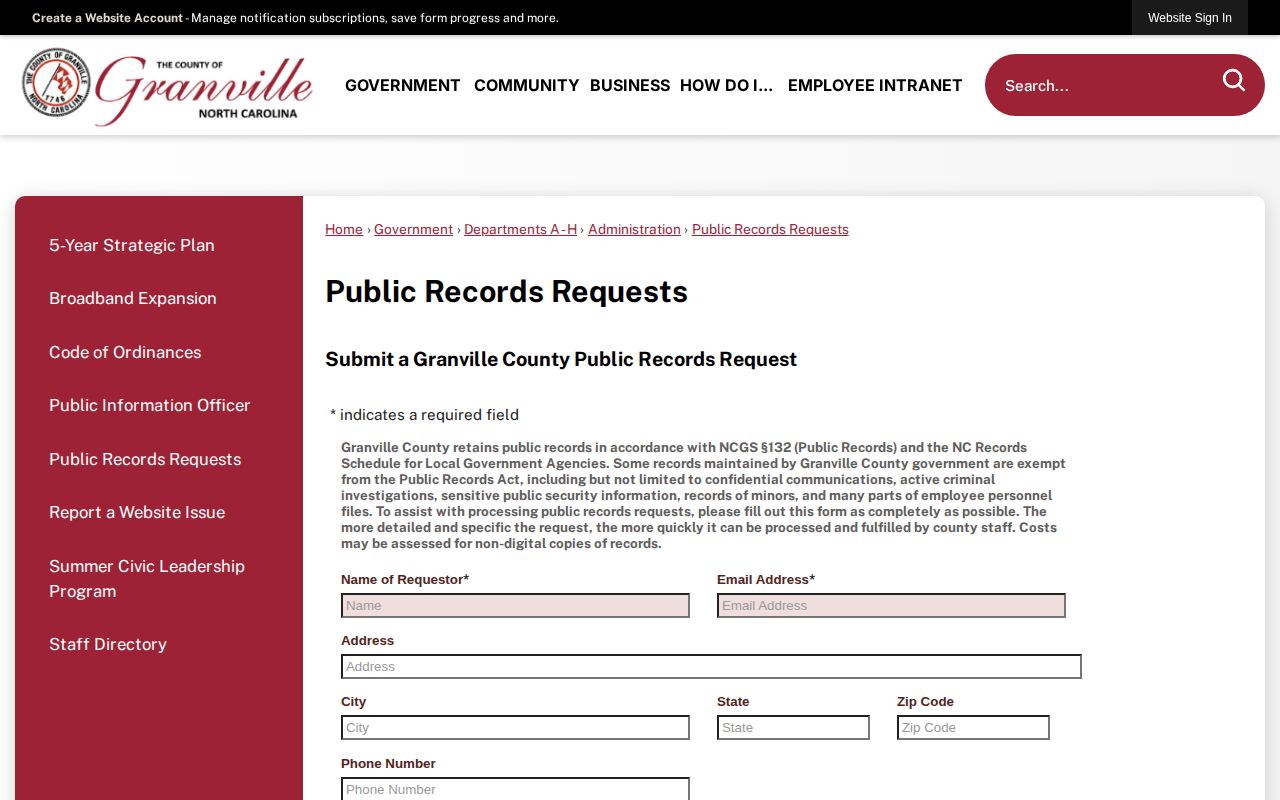
Its format and date-range choices support a focused request for an existing release entry or bounded export.
Why Detention Center Release Custody Matters
Granville County’s description of the detention center as holding people through trial and case disposition shows its local pretrial role. That role is not shared by Granville Correctional Institution or FCC Butner. The state prison holds people in NCDAC custody, while the federal complex belongs to BOP. Buildings within the same county do not share a release ledger.
The booking identifier reveals which record to use. A county booking number leads to the Sheriff. An OPUS number leads to NCDAC. A BOP register number leads to the federal locator. If a Granville County court judgment commits someone to state prison, the jail’s transfer paperwork documents the handoff and the later OPUS record documents state admission. Neither event should be called a direct release into the community.
Detention Center Custody Versus Release
The detention page lists current-custody services. On-site video visits are scheduled on weekends by last name, with Saturday for A through L and Sunday for M through Z from 1:30 to 4:30 p.m. Off-site video visits are offered daily when people are in the day room. Mail, deposits, and visitation describe an active detention stay. Their end is not a formal release event.
No official source reviewed gives a public release-processing time, exit door, family waiting point, property-return process, holiday or weekend rule, local bond schedule, jail transport stop, release count, or request turnaround. Do not fill those gaps with assumed practice. The detention telephone is the correct source for current operational instructions.
Local KARTS service and the Oxford Loop Shuttle exist, but no official source promises a jail stop, same-day walk-on service, or operation at release time. Anyone planning transportation should contact the service in advance and separately confirm the jail’s current exit procedure.
Note: A current visitation or deposit page can confirm active services, but it cannot reconstruct a past Granville County release.
Check Detention Center Release Transfers
The Granville County Clerk’s file can explain the legal outcome. North Carolina’s AOC-CR-200 Conditions of Release and Release Order documents release authority and conditions. A felony judgment can document commitment to NCDAC. Neither form replaces the jail’s executed exit timestamp, which is why the court and custodian records should be paired.
For bond, dismissal, or time served, ask whether any other case, warrant, or detainer kept the person in custody. For a state commitment, follow the person into NCDAC after intake. For a federal or immigration handoff, confirm the named receiving agency. This distinction protects the meaning of “released” and prevents a county transfer from being reported as return to the community.
Correct Detention Center Release Records
When a Granville County release entry appears wrong, contact the Sheriff’s Office with the booking number, the disputed field, and a supporting court or custody document. State the difference precisely. A mismatch between a court-order date and jail exit time may reflect two valid records that answer different questions, while the wrong release reason or receiving agency may require a correction by the custodian.
Preserve the original request, the agency response, and the date of each search. Do not resolve a conflict by silently choosing the record that seems more favorable. The Sheriff corrects county booking data, the Granville Clerk addresses court data, and NCDAC addresses an OPUS event after state admission. VINELink or NC SAVAN notification errors should go to Victim Support Services because those systems relay source-agency events.
Public access does not require broad republication. Use the least personal data needed to confirm the custody event. Full birth dates, personal contact details, victim or witness information, medical facts, and unrelated identifiers should not be repeated. If an expunction or sealing order lawfully removes the ordinary public trail, respect that result rather than rebuilding it from an old private copy.