
Granville Correctional Release Destinations
Granville Correctional Institution belongs to the North Carolina Department of Adult Correction. Its release ledger is the statewide NCDAC record. A person can leave prison on post-release supervision, parole when the sentence is eligible, or discharge. A transfer to another NCDAC institution is still state prison custody and should not be reported as release.
Prison release and full sentence completion can occur on different dates. Post-release supervision follows prison for covered sentences and places the person in the community under NCDAC control. Parole mainly concerns older or specially eligible sentences. An unconditional or completed discharge ends the status shown by the responsible record. Read incarceration and supervision events together before deciding which meaning applies.
Confirm Granville Correctional Releases
Open the NCDAC Offender Public Information Search. The seven-digit OPUS offender number is the safest search key. If it is unknown, use the person’s name and available demographic filters, then compare the conviction county, offense, sentence, and history before choosing a result.
- Search by OPUS number, or use name and filters when the number is not known.
- Open the matching record and verify identity, conviction county, offense, sentence, and prior or current location.
- Read “Inmate Status” and the incarceration history. A movement to another NCDAC prison is not release.
- Compare “Projected Release Date” with “Actual Release Date.” Treat only the actual event as proof of what occurred.
- Read “Probation/Parole/Post Release Status.” An active entry means the person may be in the community under supervision.
- Use the OPUS number in any NCDAC records request or Community Supervision follow-up.
The general search holds historical state correctional information back to 1972 and expressly excludes county-jail data. A person who only bonded out of the Granville County Detention Center may not appear. For a search spanning all three local custody systems, use the Granville County release-record route.
NCDAC Granville Release Search Fields
NCDAC also provides a dedicated Inmate Release Search for people released from state prison during the current calendar year and two prior calendar years. On the research date, the years offered were 2024, 2025, and 2026. That is a three-calendar-year index, not a rolling 36-month span and not a Granville County jail feed.
| Field or filter | How to interpret it |
|---|---|
| OPUS offender number | Stable identity key used to open and reconcile the individual NCDAC history. |
| Release county | A state release-search filter; it does not mean the Granville County jail released the person. |
| Release date | The date in the NCDAC prison-release index for that event. |
| Type of release | The agency label, such as expiration or a parole-related event, which should be preserved exactly. |
| Actual Release Date | The individual record’s completed event, distinct from an estimate. |
| Projected Release Date | An administrative estimate that can change and is not a release order. |
| Supervision status | Shows probation, parole, or post-release activity that can remain active after prison exit. |
Search results should be checked against conviction and sentence records. One date can apply to a sentence component while another reflects the overall custody or supervision path. If an old event is outside the release index, use the general historical offender search or request the basic public release data from NCDAC.
The official NCDAC inmate release search shows the current state release form.
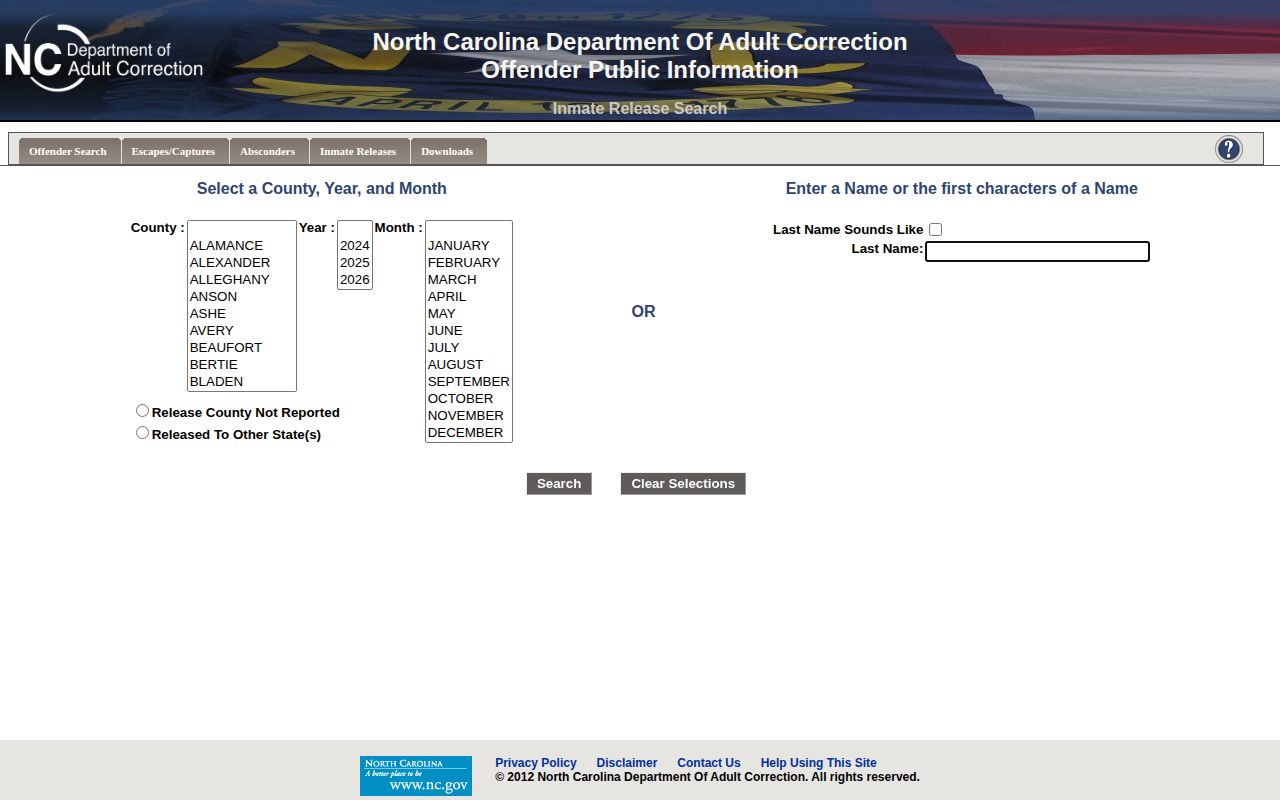
The form’s county and calendar-year controls belong to the state prison index, not a local jail roster or a promise about future release.
Granville Correctional Release Contacts
The institution’s official information identifies 1001 Veazey Road in Butner, a postal address at Box 2500, and telephone 919-964-6200. Call for current facility operations. Release calculations and historical prison events belong to NCDAC, not the Granville County Sheriff or county public-records form.
Granville Correctional Institution1001 Veazey Road
Butner, NC
Mail: Box 2500, Butner, NC
919-964-6200
Use the public offender search first. NCDAC’s Public Records process can address an existing release or discharge entry or clarify basic public admission, time-served, sentence-length, and release-date information. Most offender records are confidential, so identify the OPUS number and ask only for the specific public fields needed.
No county fee, jail request form, or Sheriff release line should be applied to this prison. NCDAC owns its correctional record. A Granville County court judgment can explain why the person entered state custody, but NCDAC controls the later prison event and sentence administration.
Note: Facility operational contacts can change; use the current NCDAC directory before relying on a visit schedule or named staff member.
Granville Correctional Institution Facts
The official NCDAC facility page describes Granville Correctional Institution as a male close- and medium-custody prison with capacity for 904. It opened in 1997 and was formerly named Polk Correctional Institution. The facility replaced Polk Youth Institution in Raleigh.
The facility name can appear in a prior-location or movement history without proving release. Confirm the person’s current status in the individual OPUS record. If another NCDAC institution is listed, the change was an intrastate prison transfer. If incarceration is inactive and an Actual Release Date appears, then inspect supervision status for the next stage.
The official facility source identifies the institution and its NCDAC role.
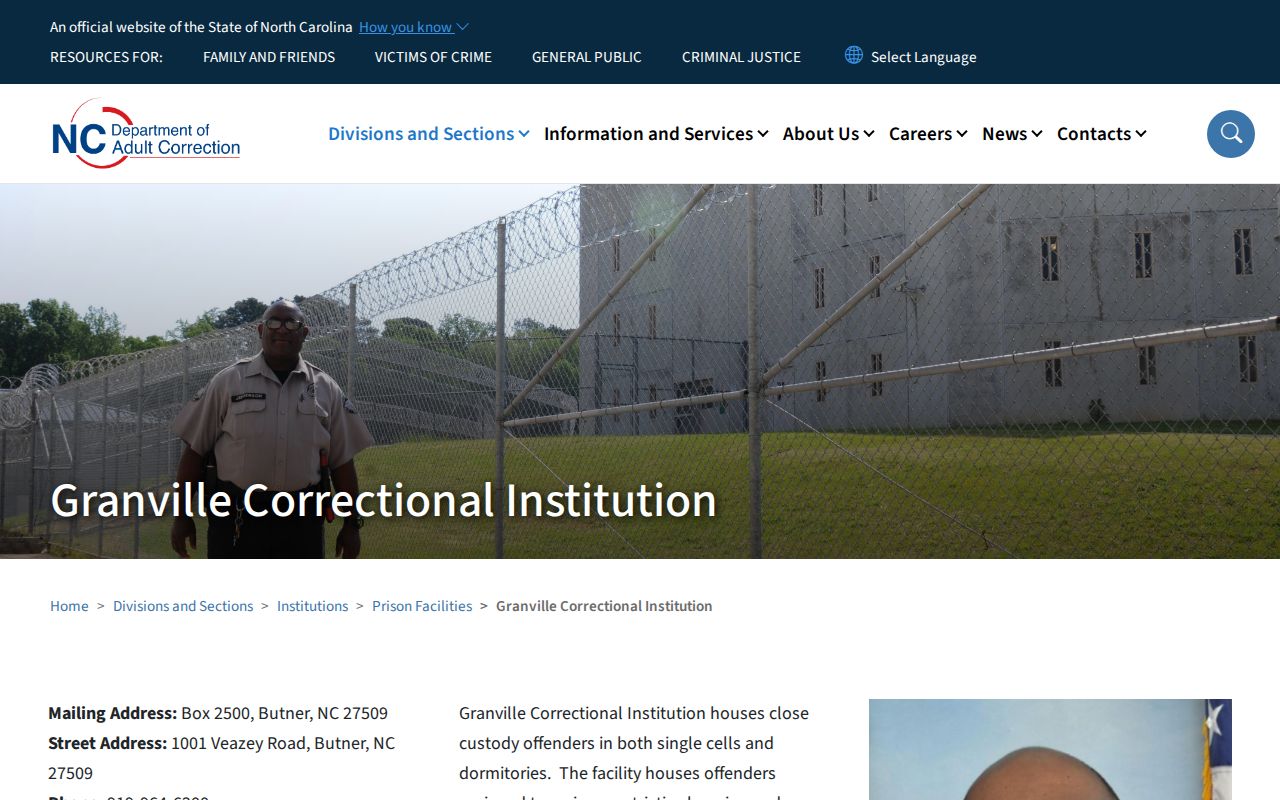
Its operator, custody levels, location, and contacts identify NCDAC as the correct record custodian.
Why Granville Correctional Is State Custody
Granville’s geography can misroute a search. The county detention center, this NCDAC prison, and FCC Butner all sit in or near the county, yet each answers to a different government. Granville Correctional Institution is not a county jail. Its residents are state prisoners, and the Sheriff cannot verify their prison release or current community-supervision status.
The OPUS number settles the system question. It links the state search, sentence history, actual and projected dates, location, and supervision record. A county booking number applies to the detention center. A BOP register number applies to federal prison. Starting with the identifier prevents a court case filed in Granville County from being mistaken for custody at a Granville County facility.
Granville Correctional Post-Release Status
A person can be released from prison while remaining under state control in the community. NCDAC labels probation, parole, and post-release supervision separately. Probation is ordered by a court. Post-release supervision follows covered prison sentences. Traditional parole generally applies to older or specially eligible sentences. Use the exact OPUS label rather than calling every supervised person a parolee.
The North Carolina Post-Release Supervision and Parole Commission sets or administers decisions within its authority, while NCDAC Community Supervision handles field supervision. Granville County is in Community Supervision Judicial District 9 with Franklin, Vance, and Warren. The researched district directory listed an office in Louisburg, but current contacts should be checked in the live directory before use.
An inactive incarceration entry paired with active supervision means prison custody ended while community control continues. Inactive incarceration and inactive supervision can support completed status when the dates match the sentence history. An absconder label is an alleged supervision status, not discharge and not a new conviction. Preserve the agency’s wording and date.
Note: Only NCDAC can reconcile credits, judgments, consecutive terms, detainers, and corrections into an authoritative state release date.
Granville Correctional Release Dates
A projected release date is based on the sentence structure and credit information known to NCDAC at that time. It can change after jail-credit review, earned credit, disciplinary action, amended judgments, appellate action, consecutive or concurrent sentence treatment, detainers, or data correction. Capture the exact field label and search date.
An Actual Release Date supersedes an earlier projection as evidence of what occurred. Pair it with inactive incarceration and the next supervision status. If the record is unclear or an old event is missing, ask NCDAC for the existing basic public release information using the OPUS number. Do not calculate a release by applying one percentage to the judgment.
Identity and time controls help preserve the result. Record the date and local time of the search, the OPUS number, and the exact period covered by the release index. A partial-name result should be checked against birth information, conviction county, docket, and offense before it is accepted. When an OPUS field appears incorrect, report the disputed label to NCDAC with the offender number and supporting judgment or custody record. The agency that owns the data should make the correction.
North Carolina court records remain useful for the sentence source. They can show the judgment, confinement credit, and later amendment, but they do not replace NCDAC’s calculation or executed prison-release event. Use the court and correctional records together when a changed judgment explains why an earlier projected date moved.